Health & Home · Compared
Swollen feet? The 4 fixes women try first add up to $227, and not one passes all 6 tests. One shoe does.
By the Nutelix team · 20 October 2026 · 6 min read

Picture a Saturday at 3pm. You're still out in the garden, or walking the mall with your daughter, and you haven't thought about your feet once all day.
That's what the right shoe feels like. Most women whose feet swell haven't felt it in years.
So we put the 4 fixes they try first through six tests, against the one shoe we built for a foot that changes size. Here's what passed, and what it costs you when a shoe doesn't.
And here's the 3pm most of us actually get
The shoes that slid on at breakfast are pressing by lunch. By mid-afternoon there's a red ring around your ankle where the top cuts in, and you're scanning the room for a chair.
You slip them off under the table and hope nobody notices. A friend suggests a walk after lunch, and you hear yourself say "maybe next time."
Then you get home and open the closet: a pair two sizes up, a pair of slippers, a pair from an ad, maybe an expensive pair from a catalog. All bought to fix this. None of them did.
It was never your feet that failed. It was one fixed size, on a foot that changes size by 3pm.
First, why your ankles swell by the afternoon

The most common reason legs swell as the years go by isn't your shoes. It's your veins: doctors call it venous insufficiency.
It usually starts after 50, it's more common in women, and it shows up the same way every day: heavy, achy legs and ankles that swell after standing and by the end of the day. Some blood pressure pills add to it. On the amlodipine (Norvasc) label, ankle swelling tops the list of side effects, at 14.6% of women against 5.6% of men. Never stop or change a medicine without asking your doctor.
What happens between 9am and 3pm

The American Academy of Orthopaedic Surgeons says your feet "may swell throughout the day (up to 8%)".
- Tiny valves in your leg veins weaken with age.
- Blood and fluid pool low, in your ankles and feet.
- Your foot gets bigger as the day goes on.
- A shoe made for your morning foot starts to squeeze.
- EasyWrap opens and adjusts to the foot you have now. Zero compression. It's the adjustable, roomy, never-tight fit NIH guidelines describe.
5. Buying a size or two up

It's the first thing most of us try. But your foot isn't one size all day. In the morning it's calm and slim. By the afternoon it's swollen and full.
Buy the size that fits at breakfast, and by 3pm the shoe is cutting in. Buy for your 3pm foot, and at 9am it's loose: your heel lifts out on every step and your toes grip to keep it on. One fixed size can't fit two different feet.
- Room for the swollen foot, by the afternoon
- No: Loose and sliding all morning
- No: Heel lifting out on every step
- No: Still one fixed size, on a foot that changes
Now picture one pair that's snug at breakfast and roomy at dinner. The strap does the changing, so you never pick a size for one time of day.
4. Slippers, all day
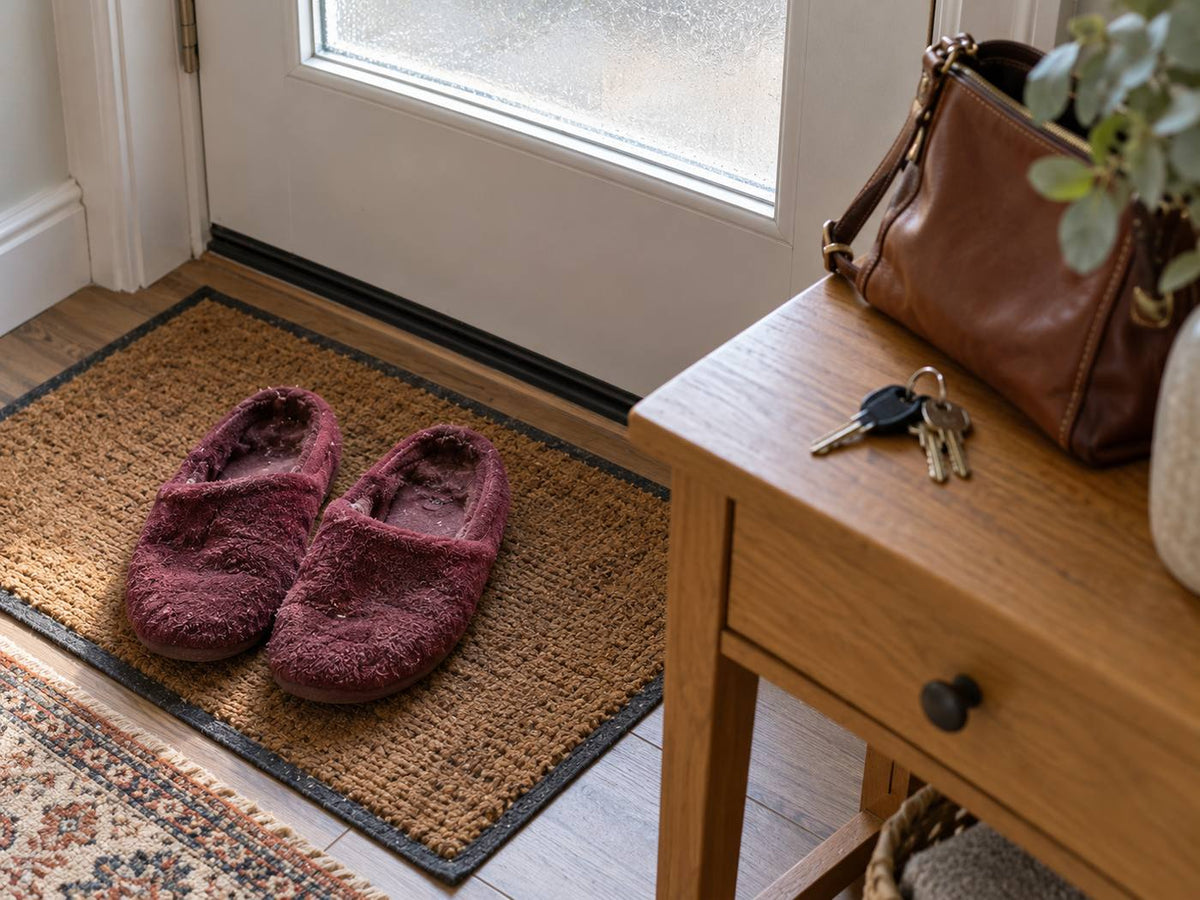
Extra-wide slippers cost around $32 to $50, they're soft, and they go on swollen feet. That's why so many women end up living in them.
But life doesn't happen in the hallway. You still have the grocery store, the doctor's office, lunch with friends, the garden. Slippers are made for indoors, and wearing them out tells everyone why.
And even at home they're no answer: in one study of 765 adults, more than half of falls at home happened in slippers, socks or bare feet (Kelsey, 2010).
- Soft and easy on
- No: Made for indoors only
- No: Not for the store, the doctor or lunch out
- No: Everyone can see why you're wearing them
Imagine walking into lunch with friends in a shoe that's just as easy to get on, and that nobody looks at twice.
3. The cheap strap shoes in your feed

You've almost certainly seen them: a cheap wide strap shoe that looks a lot like EasyWrap. Same idea, cheaper copy. Here's what women find when the box arrives:
- No: Straps too short to open the whole top, so a swollen foot still gets pushed in
- No: Set once in the morning, and fiddly to loosen when the swelling comes
- No: Thick synthetic uppers that trap heat by the afternoon
- No: No wear test: unworn returns only, so once you've walked in them, they're yours
- No: Questions answered by a chatbot, or not at all
Same idea. EasyWrap is the one built to still open wide on your most swollen afternoon, with a real person on the other end of your email.
2. Orthopedic shoes for swollen feet
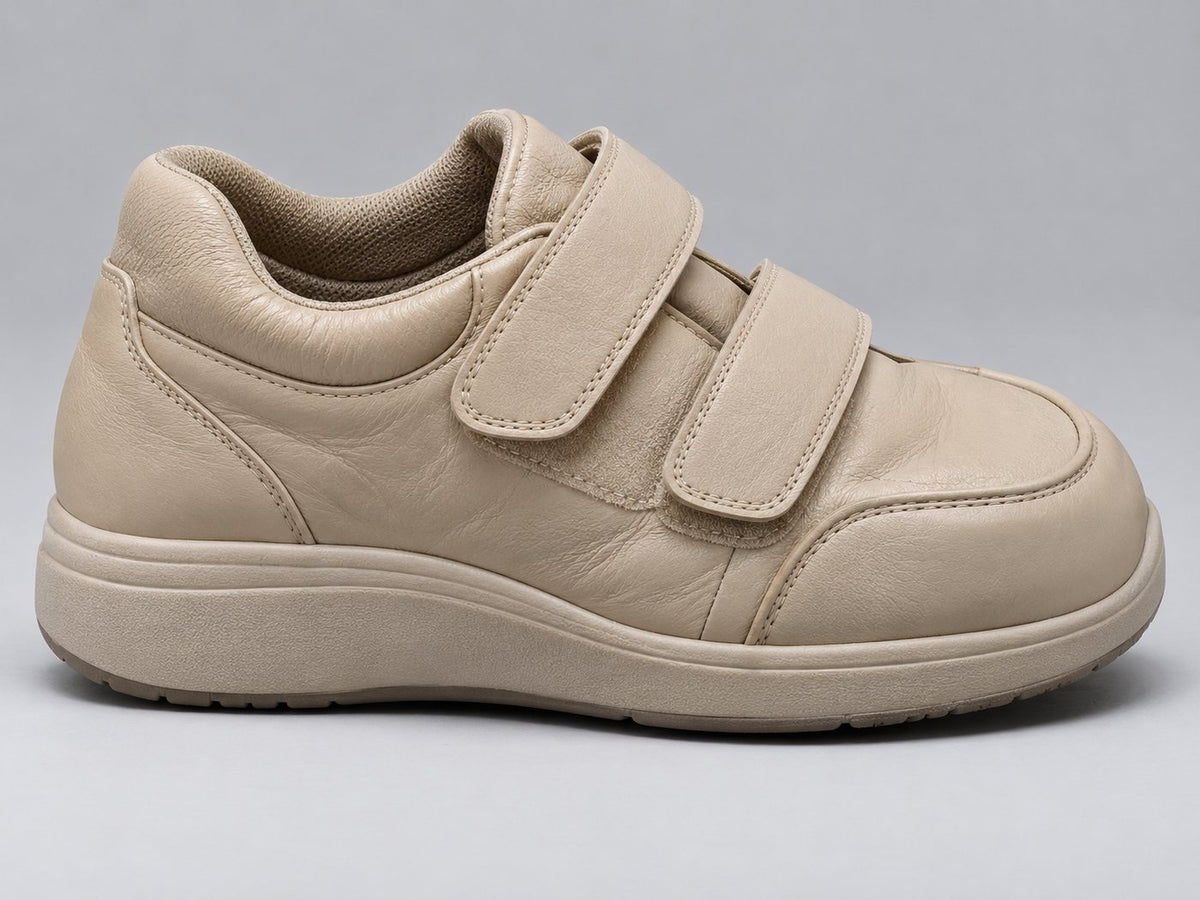
Orthopedic brands make deep, roomy shoes for swollen feet, and they're built to last. But they rarely work the way you want them to.
- Roomy and well made
- No: Bulky and heavy-looking
- No: Thick padded uppers that often don't breathe
- No: On your foot, they look exactly like what they are
- No: Up to $199 a pair
Picture the same room for a swollen foot, in a shoe that looks like any other sneaker, for less than half that price.
1. EasyWrap, made for her (our pick, and yes, we make it)
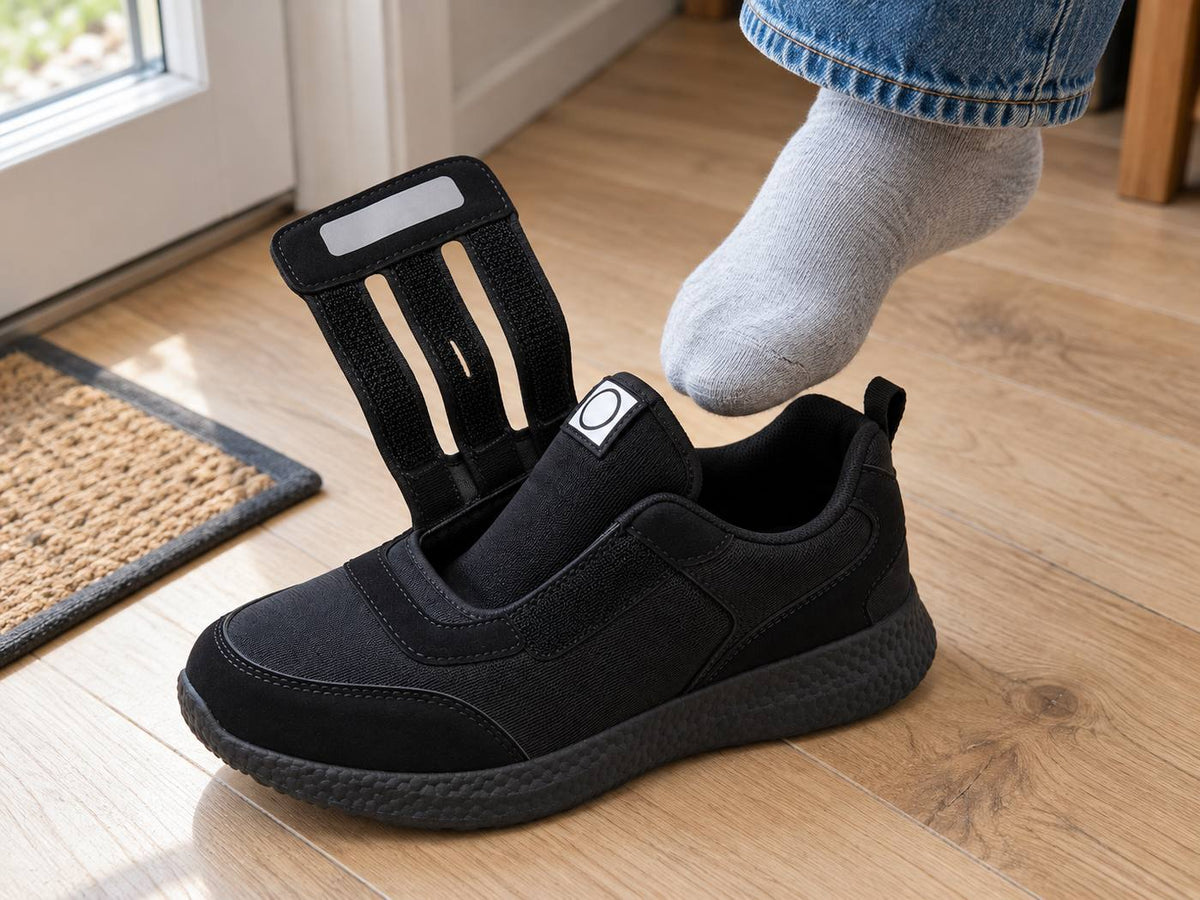
EasyWrap was made around one woman: the one whose feet swell, and who still wants to look good. One wrap-around strap lifts the whole top and opens the shoe up to 2x wider, so a swollen foot goes straight in, flat. Zero compression: it opens all the way and closes only as far as you set it. Adjusts to your foot as it swells through the day: snug at 9am, eased at 3pm.
Here's how it beats every option above:
- Beats a size up: snug in the morning, roomy in the afternoon, because the strap changes, not the size
- Beats slippers: a real sneaker for outside, not just the hallway
- Beats the cheap copies: a strap long enough for your most swollen day, eased in seconds, a breathable upper, and you can actually walk in them before you decide
- Beats orthopedic shoes: less than half the price, and it looks like an everyday sneaker
3pm on a Saturday, still out in the garden, and you haven't thought about your feet once.
Six tests, five options. The scorecard.
Here's every option on this page against the six things that matter for a foot that changes size. Only one gets a yes on all six.
| Size up | Slippers | Cheap copies | Orthopedic | EasyWrap | |
|---|---|---|---|---|---|
| Fits your 9am foot | Size up: no | Slippers: yes | Cheap copies: yes | Orthopedic: yes | EasyWrap: yes |
| Fits your 3pm foot | Size up: yes | Slippers: yes | Cheap copies: no | Orthopedic: partly | EasyWrap: yes |
| Zero compression | Size up: partly | Slippers: yes | Cheap copies: partly | Orthopedic: partly | EasyWrap: yes |
| Custom fit each time you wear them | Size up: no | Slippers: partly | Cheap copies: partly | Orthopedic: partly | EasyWrap: yes |
| Looks like a normal sneaker | Size up: yes | Slippers: no | Cheap copies: partly | Orthopedic: partly | EasyWrap: yes |
| Wear them, then return them | Size up: partly | Slippers: partly | Cheap copies: no | Orthopedic: yes | EasyWrap: yes |
Partly means true of some products in that group, not all. Orthopedic shoes get a yes on returns because some offer a 60-day wear test; the cheap copies get a no because they take back unworn pairs only. Our comparison of how each type of product works, checked 20 October 2026; not a lab test.
Now add up what the other four already cost you
Take the cheapest version of each fix on this page: a wide pair a size up ($65), extra-wide slippers ($32), a strap shoe from an ad ($45) and an entry-level orthopedic pair ($85). That's $227, and not one of them passed all six tests.
And the money isn't the worst of it. It's the afternoons cut short, the walks you turned down, the family photos you stood at the back of. Then the shoe from the ad doesn't fit, and you're typing to a chatbot about a return they won't take because you wore them once.
EasyWrap is $79.95 for one pair, with free shipping. That's $147 less than the four fixes together, and up to $119 less than a single orthopedic pair. And when you write to us, a real person writes back.
Here's the 3pm you get back

Shoes still on at dinner. Yes to the walk after lunch. The garden finished before the light goes. That's what a shoe that changes with your foot gives back.
If your feet aren't comfortable from morning to night, send them back and get every cent back. You risk nothing. The only thing you lose by waiting is another afternoon in the chair. Here's everything you get:
- EasyWrap in black or maroon, in your usual size
- Free tracked US shipping, 3 to 5 days
- 50 days to wear them: in the garden, at the store, out with friends
- Wrong size? An easy exchange
- A real person who answers your emails
Only sold on our website
P.S. Doctors say walking is especially good for your leg veins (Cleveland Clinic). That's hard in shoes that squeeze by 3pm. EasyWrap is made to keep you walking.
Questions readers ask
What about compression socks or prescription shoes?
Talk to your doctor about those: they're medical options for the swelling itself. EasyWrap is an everyday shoe, and its strap opens wide enough to make room for what you wear underneath. It is not a prescription therapeutic shoe.
Are these diabetic shoes?
They're built the way people with diabetes are told to look for: wide, roomy, adjustable, nothing pressing. They are not prescription therapeutic shoes. Check your feet every day and follow your podiatrist.
What size should I order?
Your usual shoe length. The strap handles width and swelling. Between sizes, go up one. Wrong size? We exchange it.